Alpha Erec Official Website › Blog › Does horny goat weed actually work?
Does Horny Goat Weed Actually Work?
- Icariin, the compound in Epimedium, does inhibit phosphodiesterase-5 in laboratory work. That is the same enzyme family prescription erectile-dysfunction drugs act on.
- In the one controlled human study that measured it, blood levels of icariin were very low or undetectable at every dose tested.
- A compound that does not reach the bloodstream cannot act on an enzyme in a vessel wall, however convincing the test-tube result.
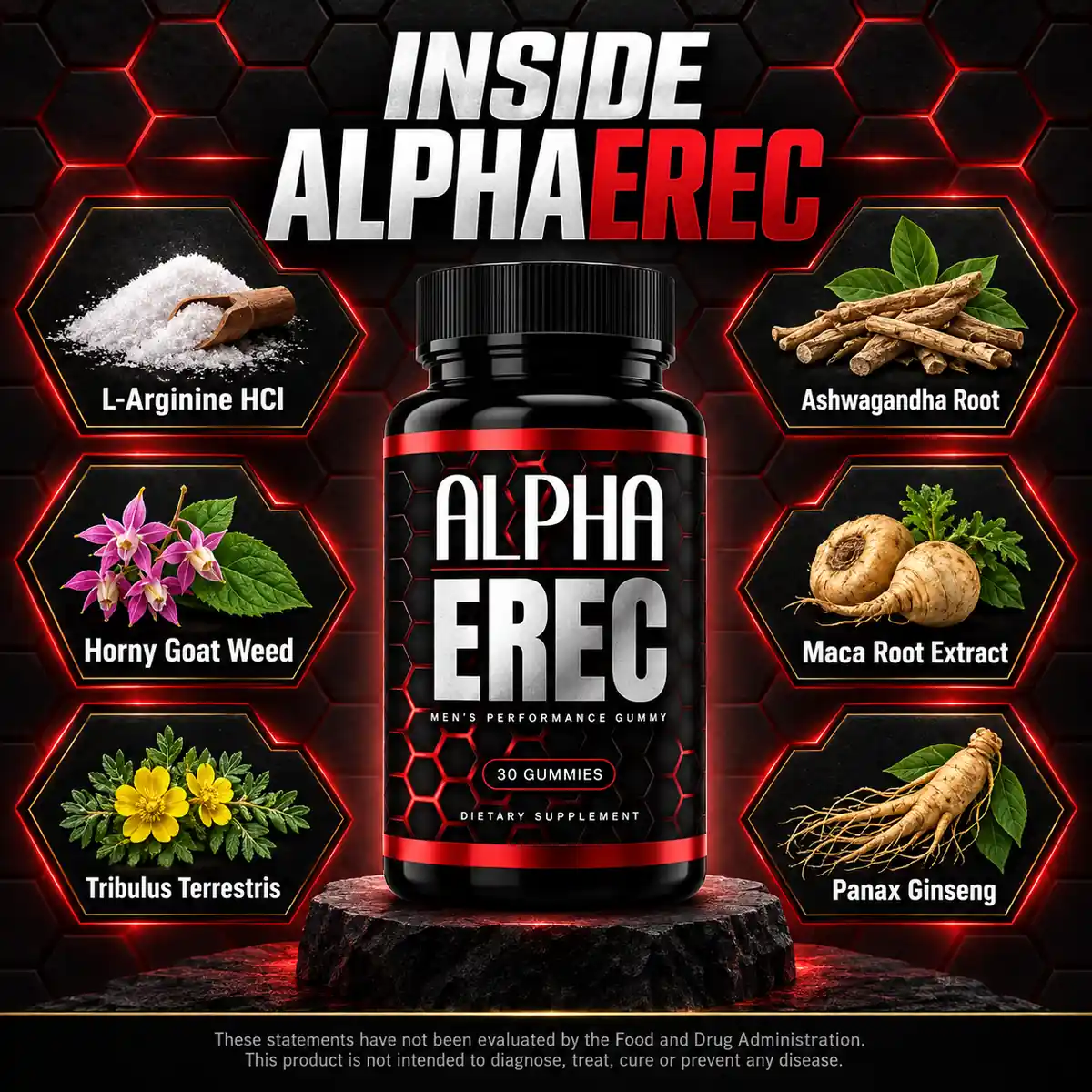
- It is on the Alpha Erec panel, at an amount that is not published, and this post is here because a page that omitted the pharmacokinetic study would be worth less than nothing.
Horny goat weed is the ingredient in this category with the largest gap between its reputation and its human evidence. It is on the Alpha Erec panel, it is on almost every competing panel, and the reason is a genuinely interesting laboratory finding that a human study then complicates badly.
What the plant is
Horny goat weed is the common name for plants of the genus Epimedium, a group of flowering perennials used in traditional Chinese medicine for centuries. Several species are used, they differ chemically, and a label that says only “horny goat weed” does not tell you which one.
That matters more than it sounds. A comprehensive ethnopharmacological and phytochemical review of the genus catalogues substantial variation in the flavonoid content of different Epimedium species and different growing regions. Two products naming the same plant can carry materially different material.
Icariin and the PDE5 story
The compound everyone is interested in is icariin, a prenylated flavonoid. In laboratory assays icariin inhibits phosphodiesterase-5, the enzyme that breaks down cyclic GMP in vascular smooth muscle.
That is precisely the enzyme prescription erectile-dysfunction drugs inhibit. Slowing its action prolongs the relaxation signal in a vessel wall, and the effect on blood flow follows. So the story writes itself: a natural compound acting on the same target as the pharmaceutical, available without a prescription.
Everything in that paragraph is true in a test tube. The question a buyer needs answered is whether it is true in a person, and that requires the compound to reach the bloodstream in meaningful quantity.
The problem: it does not get into the blood
A randomised, double-blind, placebo-controlled trial of Epimedium prenylflavonoids, published in Phytomedicine in 2021, set out to examine safety, pharmacokinetics and effects. Pharmacokinetics is the study of what happens to a compound after it is swallowed: how much is absorbed, how high blood levels go, and how long it stays.
The finding that matters here is blunt. At every dose tested, blood levels of icariin were very low or undetectable. The investigators could not characterise its pharmacokinetics because there was not enough of it in circulation to measure.
| Claim | Evidence | Status |
|---|---|---|
| Icariin inhibits PDE5 | Laboratory assays | Established in vitro |
| Epimedium contains icariin | Phytochemical analysis | Established, with wide variation |
| Oral icariin reaches the bloodstream | Controlled human trial | Very low or undetectable |
| Oral Epimedium improves erectile function in men | — | No adequate trial |
Read that table from the top and the story gets better; read it from the bottom and it gets worse. Both directions are honest, and the bottom two rows are the ones that describe what happens when somebody swallows a gummy.
Alpha Erec publishes the awkward research too
Six named botanicals, one gummy a day, and a site that links the study undermining an ingredient on its own label rather than leaving it out.
$207 for three bottles, $69 each, free US shipping
Order Alpha Erec On The Official WebsiteWhat the wider literature contains
It is worth being precise about what does and does not exist, because “no evidence” is usually an overstatement and “clinically proven” is always one.
- Extensive laboratory work. Icariin has been studied in cell and enzyme systems across many fields, and the PDE5 result is real within those systems.
- Substantial animal work. Rodent studies report effects on erectile tissue, usually at doses and by routes that do not translate directly to a person taking a gummy.
- Traditional use spanning centuries. Genuine, and not the same kind of evidence as a trial. NCCIH is good on how to weigh traditional use without either dismissing it or treating it as clinical proof.
- Very little controlled human work on erectile function specifically, and the best human pharmacokinetic study finds the active compound barely arriving.
A fair summary is that horny goat weed is a plausible candidate that has not been shown to work in people at oral doses, and that the most likely reason is absorption.
Why it is on almost every label anyway
Three reasons, none of them about efficacy.
The name sells
“Horny goat weed” does more marketing work than any claim a label is permitted to make. It communicates a category and an intent without triggering a single regulatory problem, because it is just a plant name.
The mechanism story is genuinely good
A natural PDE5 inhibitor is a compelling sentence, and it is true at the level a sentence operates. Nobody writing a product page has to invent anything.
Category convention
Once an ingredient is on every competing panel, leaving it off looks like an omission to a buyer comparing labels. Formulation in this category is partly a copying exercise, which is also why the next ingredient is on almost every panel.
The other ingredient with the same problem
Tribulus terrestris sits beside horny goat weed on this panel and on most others, and it has the same shape of problem with a clearer resolution.
A 2014 systematic review concluded that tribulus is ineffective for raising testosterone in humans and that the marketing claims made for it are unsubstantiated. A 2025 systematic review of clinical trials in men reached the same conclusion: low-level evidence on erectile function, and no robust evidence for testosterone. Two independent reviews, eleven years apart, agreeing is about as settled as this literature gets.
The difference between the two ingredients is worth naming. Horny goat weed has a plausible mechanism and an absorption problem. Tribulus has a plausible mechanism and a run of trials that failed to find the effect. Neither is dangerous. Both are on the panel because the category expects them.
Safety and interactions
Poor absorption is not the same as no effect, and the safety notes stand regardless.
- Cytochrome P450 3A4. Epimedium constituents interact with this enzyme system, which metabolises a great many prescription drugs. That is a reason to ask a pharmacist.
- Blood thinners. Worth checking, as with several botanicals on this panel.
- Reports of mood change and palpitations exist at higher intakes, and are the sort of thing a label does not mention.
- Do not exceed the labelled serving. One gummy a day, and the amount inside it is not published.
The NIH Office of Dietary Supplements consumer sheet is the right place to start if you want the general version of how to think about any of this. Our own safety page lists the interactions botanical by botanical.
How to spot this pattern on any label
The shape of this ingredient’s story repeats across the supplement aisle, and once you can recognise it you can apply it to anything.
The pattern runs: an interesting compound is identified in a plant, it does something striking in a laboratory assay, the result is genuine, and the marketing then treats the assay as though it were a clinical trial. The step that goes missing is always the same one, and it is always the hardest: does the compound survive digestion, reach the bloodstream, and arrive at the tissue in a quantity that matters?
| Question | What answers it | How often it is answered |
|---|---|---|
| Does the compound do something? | Laboratory assay | Usually |
| Is it in the plant? | Phytochemical analysis | Usually |
| Does it reach the blood when swallowed? | Human pharmacokinetic study | Rarely |
| Does the finished product change an outcome? | Randomised controlled trial | Almost never |
Horny goat weed passes the first two and fails the third in the one study that looked. Most ingredients in this category are never tested on the third question at all, which is a different and quieter problem: an absence of evidence rather than evidence of absence.
The practical use of this is simple. When a product page cites a study, check which of those four rows the study belongs to. A cell-culture result and a randomised trial in men are both called research, and they are not remotely the same claim.
The honest verdict
If horny goat weed is the reason you are considering a product in this category, read the pharmacokinetic study first. It is the single most relevant piece of human evidence about this ingredient and it is not encouraging.
If it is simply one name among several on a panel you are buying for other reasons, it is unlikely to be doing harm and unlikely to be doing much else. On the Alpha Erec label it sits alongside an ingredient list whose better-evidenced members, arginine and ginseng, carry the stronger case. Those are covered in our post on L-arginine and on the ingredients page.
What would change this verdict is a controlled human trial of an oral Epimedium preparation measuring erectile function, with the icariin content of the preparation stated. That study does not exist. Until it does, the honest position is the one on this page.
- Yong EL, Wong SP, Shen P, Gong Y, Li J, Hong Y. Randomized, double-blind, placebo-controlled trial to examine the safety, pharmacokinetics and effects of Epimedium prenylflavonoids, in bone specific alkaline phosphatase and the osteoclast adaptor protein TRAF6 in post-menopausal women. Phytomedicine. 2021;91:153680. https://pubmed.ncbi.nlm.nih.gov/34352588/
- Ma H, He X, Yang Y, Li M, Hao D, Jia Z. The genus Epimedium: an ethnopharmacological and phytochemical review. J Ethnopharmacol. 2011;134(3):519-41. https://pubmed.ncbi.nlm.nih.gov/21215308/
- Qureshi A, Naughton DP, Petroczi A. A systematic review on the herbal extract Tribulus terrestris and the roots of its putative aphrodisiac and performance enhancing effect. J Diet Suppl. 2014;11(1):64-79. https://pubmed.ncbi.nlm.nih.gov/24559105/
- Vilar Neto JO, de Moraes WMAM, Pinto DV, da Silva CA, Caminha JSR, Nunes Filho JCC, Reis CEG, Prestes J, Santos HO, Daher EF. Effects of tribulus (Tribulus terrestris L.) supplementation on erectile dysfunction and testosterone levels in men: a systematic review of clinical trials. Nutrients. 2025;17(7):1275. https://pubmed.ncbi.nlm.nih.gov/40219032/
- National Center for Complementary and Integrative Health. Dietary and herbal supplements. https://www.nccih.nih.gov/health/dietary-and-herbal-supplements
- National Institutes of Health, Office of Dietary Supplements. Dietary supplements: what you need to know. https://ods.od.nih.gov/factsheets/WYNTK-Consumer/
Every page, every journal post, the bottle facts and the ingredients go through review by Dr. Arthur Burnett II, MD before they ship. We write from the Alpha Erec label, the vendor’s own listing artwork and this desk’s paperwork. Every study cited here was opened and checked before it was linked, and we print “not published” wherever a figure is withheld rather than estimating it. Corrections go to [email protected] and move the review date forward. Last updated September 2026.